
Another massive bird migration forecast statewide for the night of May 14
Birds are racing to their nesting grounds; help them arrive safely by turning off nonessential outside lights at night
Media contacts:
Lisa Gaumnitz, Lights Out Wisconsin and Coordinator of SOS Save Our Songbirds, 608-235-2201, lisa.gaumnitz@sossaveoursongbirds.org
Brenna Marsicek, Lights Out Wisconsin and Outreach Director of Southern Wisconsin Bird Alliance, 608-255-2473; bmarsicek@swibirds.org
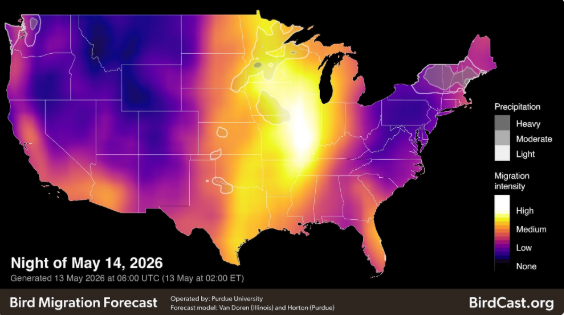
White-hot bird migration is forecast over Wisconsin the night of May 14 as this map shows.
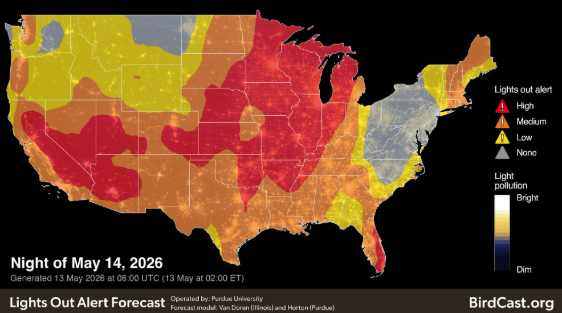
Lights Out Alerts are issued in areas shown in red on the map on the right. Source: Purdue AeroEco Lab
Madison, May 13, 2026 – Another massive wave of migrating birds is on its way to Wisconsin, bringing calls from scientists to turn off non-essential outdoor lights on the night of May 14 and other nights over the next two weeks when Lights Out Alerts are forecast in some or all of the state.
"Certain nights bring massive surges of birds moving north, and Wisconsin sits directly in the path of some of the continent’s busiest spring migration corridors,” says Kyle Horton, the Purdue University associate professor who along with Cornell Lab of Ornithology colleagues uses weather radar to generate bird migration forecasts and alert people when birds are most at risk.
“Turning off unnecessary lights at night is one simple step we can take to help migratory birds pass safely through our skies."
Eighty percent of migrating birds fly at night, and artificial light can lure them off their migration paths into urban areas where they face more hazards, including windows. Up to 3.5 billion birds die every year in the United States after colliding with windows. It’s a major reason why 30% of North American birds have disappeared since 1970.
Scientists issue a Lights Out Alert whenever bird traffic is within the top 10% of nights in an area, about 8 to 10 nights a season. These nights account for about 50% of the migration traffic. People are urged to turn off non-essential outdoor lights from 11 p.m. to 6 a.m. on May 14 and for those nights when Lights Out Alerts are issued for specific areas. Sign up to get email alerts for Appleton, La Crosse, Madison or Milwaukee or a city within 100 miles of where you live. See a map showing cities with email alerts.
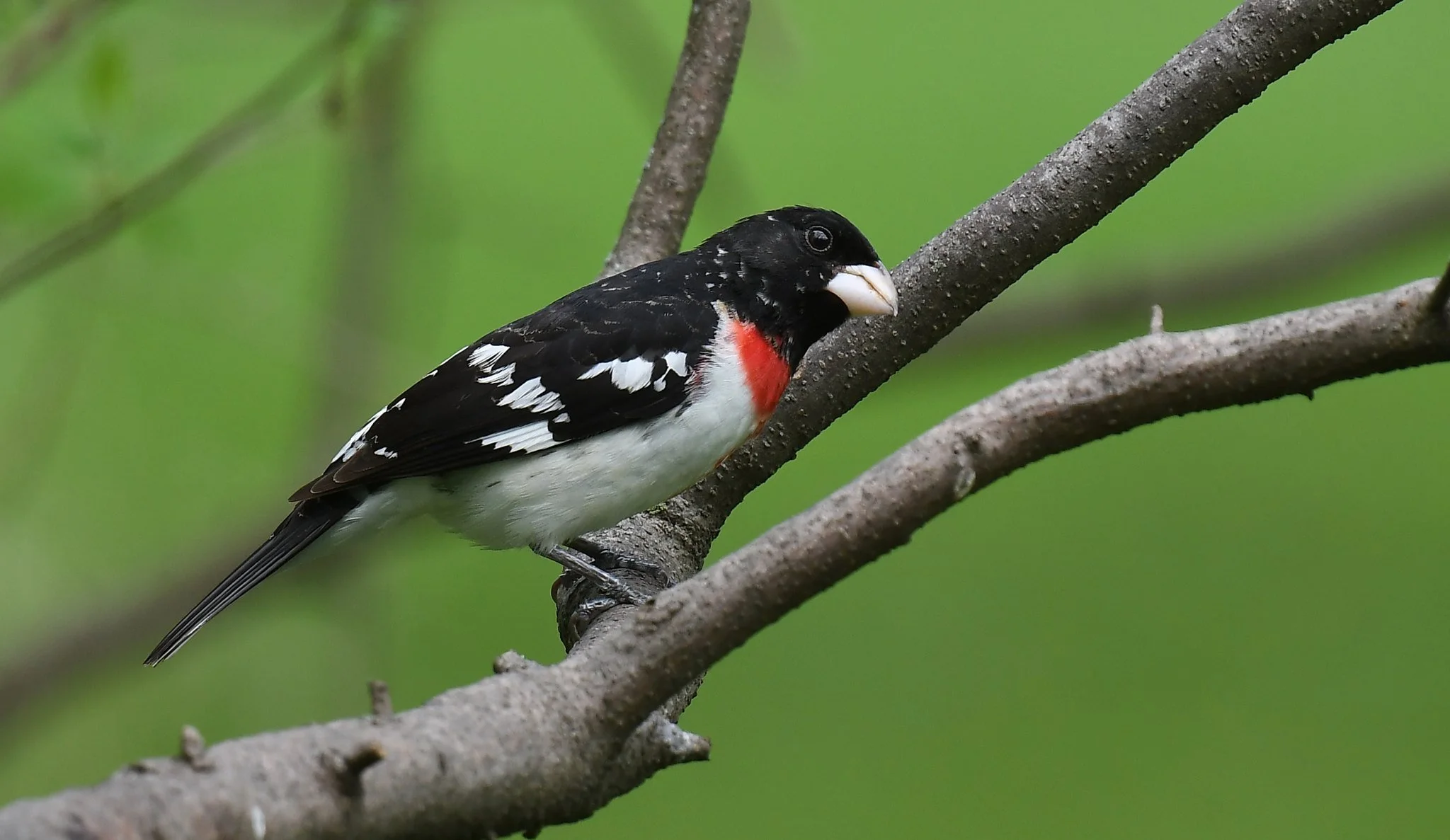
Rose-breasted Grosbeak by Andy Reago & Chrissy McClarren FCC
Hundreds of millions of birds, 400+ species racing to claim best nesting territories
During spring migration, birds are in a rush to claim the best nesting territory. Horton’s recent research has shown birds fly 39% faster in the spring, some due to more favorable wind conditions but also birds flying 2.3 meters faster per second.
A whopping 37 million birds flew over Wisconsin on May 11, 2026, far exceeding even the high levels (17 million) predicted by Horton and Cornell scientists. There are still millions and millions more birds to come.
Nearly 230 bird species nest in Wisconsin and another 200 species pass through to nesting grounds in Canada and other parts of the Arctic Circle. Peak migration – when 50% of nighttime bird migration traffic historically passes through each county – starts the first week in May in Wisconsin and ends the third week. The peak starts and ends a few days later in Northern Wisconsin, based on radar measurements from 1995-2018, according to BirdCast.
Lights Out Wisconsin formed in fall 2025 to reduce light pollution when dark skies matter most for wildlife and people. Promoting signups for Lights Out Alerts and helping people treat problem windows for birds are key strategies to achieve that goal of bird conservation.