
Peak bird migration arrives early and triggers Lights Out Alert overnight Wednesday, Aug. 26!
Tune in at 7 p.m. that night for online talk by scientist behind the alerts
Contacts: Brenna Marsicek, Lights Out Wisconsin member and Southern Wisconsin Bird Alliance Outreach Director, bmarsicek@swibirds.org
Lisa Gaumnitz, Lights Out Wisconsin member and SOS Save Our Songbirds Coordinator, lisa.gaumnitz@sossaveoursongbirds.org
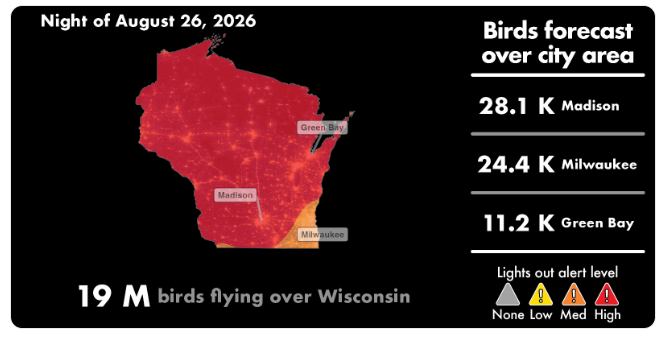
Scientists forecast high levels of bird migration over Wisconsin overnight tomorrow, Wednesday, Aug. 26.
Madison, Aug. 25, 2026 – Extremely high bird migration is expected over Wisconsin tomorrow, Wednesday night, Aug. 26, triggering a Lights Out Alert nearly statewide as peak bird migration arrives a bit early.
People are urged to turn off non-essential outdoor lights overnight from 11 p.m. to 6 a.m. during fall migration and particularly on high migration nights to reduce risks to birds.
A perfectly aligned free online presentation from one of the key scientists behind the Lights Out Alerts is set for 7 p.m. on Wednesday, Aug. 26. Dr. Kyle Horton of Purdue University’s Aeroeco Lab will share the science behind the alerts and how weather radar is used to forecast bird migration intensity. Register now to join the discussion live or receive a recorded version after.
“We’re getting some signs peak migration is coming early, so Dr. Horton’s talk is coming at the perfect time,” says Brenna Marsicek, a part of the Lights Out Wisconsin coalition and outreach director for Southern Wisconsin Bird Alliance.
“Over 1,500 Chimney Swifts were counted at Cherokee Middle School in Madison on Aug. 22, and that typically happens in southern Wisconsin at the very end of August and early September.”
“We encourage everybody to start turning off their outside lights at night for the next month or so if they can, and for sure to do that when such high migration nights are forecast,” Marsicek says.
While fall bird migration gets underway as early as late July, peak bird migration begins Sept. 1 in some northern Wisconsin counties and a few days later in southern Wisconsin, according to BirdCast, based on historical weather radar data.
Eighty percent of migrating birds fly at night, and artificial light can lure them off their migration paths into urban areas where they face more hazards, including windows. Collisions with windows kill up to 3.5 billion birds every year in the United States and are a leading reason why nearly 30% of North American birds have disappeared since 1970.
Purdue and Cornell scientists forecast the intensity of bird migration over the continental U.S. using weather radar in fall and spring migration periods. Forecasts are updated every six hours. The scientists issue a Lights Out Alert whenever bird traffic is within the top 10% of nights, about 8 to 10 nights a season. Appleton, La Crosse, Madison and Milwaukee are among cities nationally where alerts are now available. Sign up to get email alerts for those cities—or a city closest to you.
Lights Out Wisconsin formed in fall 2025 to reduce light pollution when dark skies matter most for wildlife, people and dark skies.
